You can run a trivia night with a microphone, a TV and a stack of questions. Running one that fills the room every week takes a little more thought.
We host weekly trivia in bars, restaurants and corporate rooms around New York, and we’ve learned the difference between a night people tolerate and a night they put in their calendars. This guide is how to host a trivia night that actually works: the room setup, the schedule, the format, the questions, the scoring, and the honest answer on when to bring in a pro.
Key takeaways
- Pick a slow night and commit to it weekly. Mondays through Thursdays, 7–9pm, same slot every week.
- Cap team size at five. Bigger teams hoard the smart people and shrink your headcount.
- Difficulty is the whole game. A third easy, a third medium, a third hard, and everyone stays engaged.
- Promote before you’re good at it. Consistency and repetition beat clever one-off marketing.
- Hire out when the setup costs more than the event earns. Question writing, hosting and no-shows add up fast.
What a trivia night actually needs
Five things. Get any one wrong and the night sags.
Space. Teams need to sit together, see a screen, and hear the host. If people in the back are asking “what was the question?” you’ve already lost them. Pick the section of the room with the fewest blind corners, and don’t put teams near the bar where the blender lives.
Sound. One clear microphone beats a loud one. Test it at the volume of a full room, not an empty one. If you don’t own a system, a wireless mic and a small speaker will cover most bar floors – that’s what we carry into venues that don’t have one.
A host. Not a reader. Somebody who keeps score, keeps pace, and can fill ten seconds when the app hiccups. The host decides whether the night feels like a game show or a staff meeting.
Questions. Enough of them, sorted by difficulty, in a format that doesn’t create arguments.
Prizes. Small, fast to redeem, and worth bragging about.
One more thing that’s easy to forget: WiFi. Our games run on phones, so we ask every venue for WiFi and, ideally, one TV we can cast to. That’s the entire technical requirement.
Pick the best night and time (and don’t move it)
Host on a night you don’t need help with. Most of our venues run Monday through Thursday, because Tuesday at 8pm needs a reason to exist and Saturday at 8pm doesn’t.
Then look at your own calendar before you look at anyone else’s:
- Which night is your softest? Not the worst night of the month – the reliably soft one.
- What already happens that week? Trivia loses to a standing karaoke night, a dart league, or a big game on the TVs.
- Can the kitchen handle a rush at 7:30? Trivia crowds order in bursts, between rounds.
Start at 7pm and wrap by 9pm. That leaves the room open for the late crowd, gives your staff time to reset, and gets people home on a weeknight – which is what makes them willing to come back next week.
The single most common scheduling mistake is moving the night around. Weekly and fixed beats occasional and convenient. Our partners who treat trivia as a standing appointment are the ones who get a regular following out of it.
Choose a format and team size
There are three formats worth considering.
The classic pub quiz. Teams write answers on paper, rounds of eight to ten questions, host reads them aloud and collects sheets. Cheap to run, easy to understand, and slow – marking takes real time, and the room gets restless.
Multiple-choice, app-based. Players answer on their phones, one question at a time, against a clock. Scores update live, so nobody waits for the host to do arithmetic. This is how we run every 123 Trivia night.
The game-show format. Big screen, timed rounds, escalating point values, visible leaderboard. More energy, more setup, and it needs a host with personality.
Whatever you choose, write the rules down and read them once at the top. Phones for answers, not for searching – say it out loud, and say it again in round two.
Cap your teams. We hold the line at five players per team, and it’s not arbitrary. Six-player teams mean fewer teams, more dead weight, and a table ordering four drinks instead of eight. Smaller teams spread the same people across more tables, which is better for the room and better for the tab.
We also split our night into three independent games across two hours instead of one long scoreboard. Each game takes about 30 minutes and pays out on its own, so a team that bombs round one still has two reasons to stay. That structure is a traffic decision as much as a game decision – nobody leaves at 7:45 after a bad start.
Write or source trivia night questions – and balance the difficulty
This is where DIY trivia lives or dies.
If you’re writing your own trivia night questions, follow the same rules test writers use. Carnegie Mellon’s Eberly Center recommends one clearly best answer per item, plausible wrong answers, no double negatives and no “all of the above” – advice that translates directly to a bar. Their guidelines are worth ten minutes of your time.
A few more, from doing this weekly:
- Mix the difficulty. Roughly a third easy, a third medium, a third hard. If the top team scores 18 out of 20, it was too easy. If the winning score is 11, it was too hard.
- Rotate categories. Ours spans 400+ categories, from pop culture and movies to sports, history and music. Rotating keeps regulars from memorizing your style.
- Theme it. A Taylor Swift night or a 2000s throwback pulls a different crowd than general knowledge. Some of the best trivia night ideas are just a theme plus a playlist.
- Test on staff. Hand your pub quiz questions to a bartender who isn’t playing. If she argues about the answer, cut the question.
- Fact-check every answer the night before, not during. Nothing kills a room like a host saying “actually, I think it’s the other one.”
Bad questions don’t just cost you a round. They cost you the team that got it right and lost anyway.
Run the night step by step
Here’s the run of show we use. It works for a 40-person room and a 140-person room.
30 minutes out: Test the mic, the screen and the WiFi. Print nothing – if you’re app-based, you don’t need it.
15 minutes out: Sign-ups. Keep it to a name, a team size, and a phone. We take sign-ups at the table so people are already seated and ordering when the game starts.
0:00: Rules, prizes, housekeeping. Sixty seconds, then question one.
Rounds: Read each question once, cleanly, then start the clock. Answer options stay on screen. Don’t repeat the question three times – it kills the pace and rewards inattention.
Between rounds: Leaderboard on screen. Call out the bottom of the table too; those are the teams you want back next week.
Scoring: Announce it before you start. Right answer plus speed is the cleanest system, and with an app it’s automatic. If you’re on paper, score between rounds, not mid-round.
Tiebreakers: Have two ready – a sudden-death question, and a closest-to-the-number question as backup. Decide the method before the night, say it out loud, and never negotiate with the table. Announcing the tiebreak rule at the top prevents the only argument you’ll ever really have.
End on time. Two hours. People remember a night that respected their Tuesday.
Promote it so people show up
You’re not marketing one event. You’re building a habit.
- Fix the identity. Same night, same time, same name. “Tuesday Trivia at [venue], 7pm” is a brand. Rotating themes without a fixed slot is a scheduling problem.
- Post it on Google. Use an Event post on your Google Business Profile – Google walks through it here. It’s free exposure to people already searching for something to do tonight.
- Mark it up on your site. If you list events on your own website, add Event structured data so Google can surface the date and time in search; the requirements are here.
- Show the room, not the logo. Photos of winning teams holding their prize cards outperform any graphic we’ve ever posted.
- Give hosts the assets. We hand venues ready-to-post graphics and copy so their own channels do half the work. Ask your host for theirs.
- Start early and repeat. Announce two weeks out, then weekly. One post the day of is not promotion.
A real example: one of our West Village nights runs every other Tuesday at 7pm, and the venue re-posts the schedule with the upcoming dates listed. Regulars plan around it because the information isn’t a scavenger hunt.
Prizes that work
Prizes should be cheap for you, fast to redeem, and worth posting about.
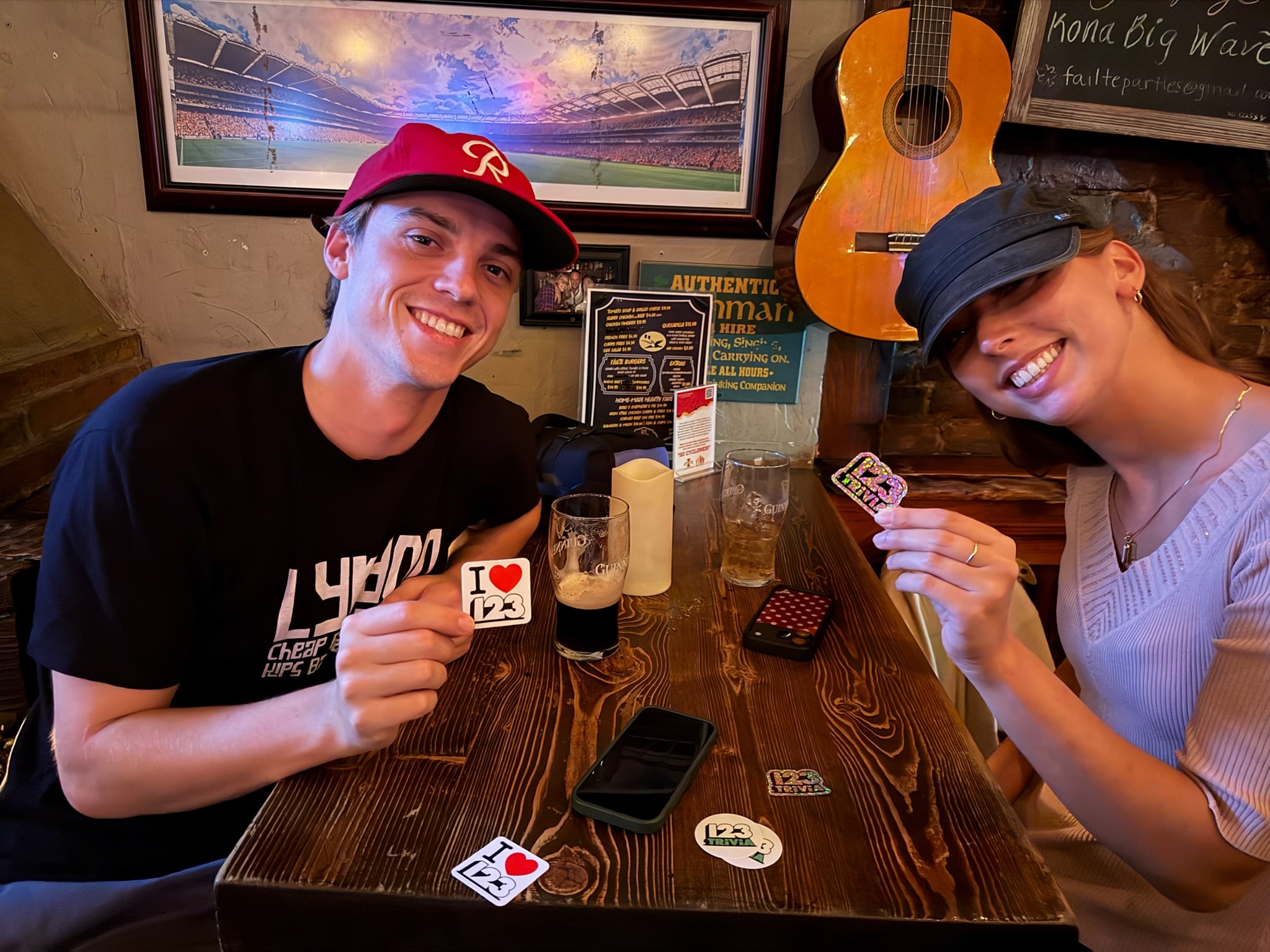
What we run at 123 Trivia: first place gets a free round of drinks, second gets $10 off the tab, and the top three teams all get stickers that players genuinely collect. The stickers cost almost nothing and travel further than the drink tab – people put them on laptops and water bottles.
A few rules that hold up across venues:
- Keep redemption same-night or simple. A prize that requires a return visit on a Tuesday in three weeks is a coupon, not a prize.
- Avoid big cash pots. They attract ringers, and ringers clear out your regulars.
- Make the win visible. Winners holding a card, a round of applause, a photo. The recognition is the prize; the drink is the receipt.
- Match the room. A cocktail bar’s prize isn’t a pitcher. Ask your host what’s landed at other venues.
Common mistakes (we’ve made most of them)
- Questions too hard. The most common failure, and the easiest to fix.
- No cap on team size. Six-person teams look like a crowd and behave like a clique.
- Bad sound. If the host has to shout, the room stops listening by round two.
- Blind spots. Tables that can’t see the screen are tables that stop playing.
- Starting late. Regulars arrive on time. Don’t punish them.
- Skipping promotion because the room was full last week. It was full because you promoted last week.
- Making the host do everything. Host, scorekeeper, photographer and bouncer is four jobs.
- No tiebreak rule. You will need one in week one, guaranteed.
When to hire a professional host instead of doing it yourself
DIY trivia is the right call for a one-off fundraiser, a small café with a regular crowd, or a staff member who genuinely wants to run it. It stops being the right call when the math turns.
Count the real cost: 20 sets of questions a month, printing, a sound system, a backup host for the night your GM is sick, and the staff hours to run all of it. Then count what happens when your host leaves.
A professional trivia night host brings more than questions. They bring pacing, crowd work, a scoring system that doesn’t argue, and – at our venues – their own following. Our weekly live trivia is built as a traffic program: we assign a host, supply every question through the 123 Trivia app, manage setup, gameplay and scoring, and promote each night through our own website, email and social channels. Your team pours drinks.
The venues that get the most out of it treat trivia as a program, not an experiment: one fixed night, weekly, promoted like a standing event. That’s the whole trick.
Ready to stop writing questions? Talk to us about hosting weekly trivia at your bar or restaurant. And if you’re the person who’s been unofficially hosting for six months and loving it, become a 123 Trivia host.
FAQ
How long should a trivia night be? Two hours is the sweet spot for a weeknight. We run three separate games of roughly 30 minutes each, with prizes after every game, so there are multiple chances to win and no reason to leave early.
How many players should be on a team? Cap it at five. Smaller teams mean more tables full of paying customers, faster scoring and a fairer game. We cap every 123 Trivia team at five.
Do you need special equipment to host a trivia night? Less than you’d think. WiFi and one TV you can cast to will run an app-based game; a wireless mic and speaker covers most rooms. If you’re going pen-and-paper, add answer sheets and pens for every team.
Is it better to write my own trivia night questions or use a host? Write your own for a one-off or a themed party. Go with a professional host once trivia is a weekly commitment – the question bank, the pacing and the reliability are the product.